Examples of Math Heuristics in Action
1. Draw a Diagram or Model
What it involves:
This heuristic helps children visualise the relationships in a problem. Common tools include bar models, number lines, or simple diagrams.
Sample Question and Application of Heuristic:
An adult ticket costs $6 more than a child ticket. 2 adults and 3 children paid $82. What is the cost of a child’s ticket?
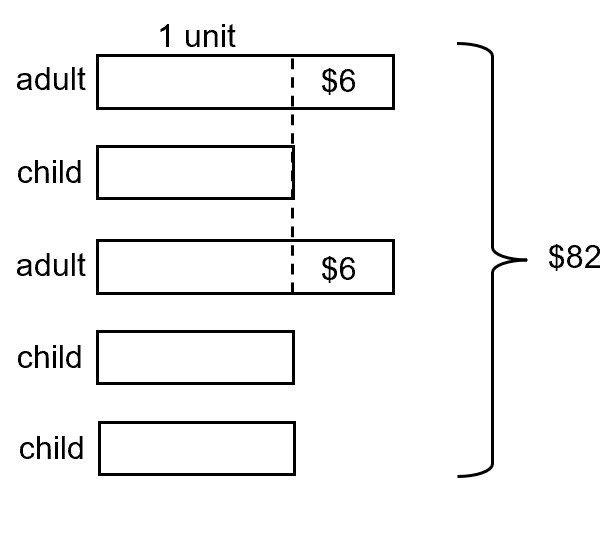
$6 × 2 = $12
$82 – $12 = $70
5 units = $70
1 unit = $70 ÷ 5 = $14 (ans)
2. Look for Patterns
What it involves:
This involves identifying repeated structures or trends to predict what comes next or to generalise a rule.
Sample Question and Application of Heuristic:
The first few terms of a number sequence is given by 5, 8, 11, 14, …
What is the 100th term?
See that we need to add 3 to obtain the next term. Also we can rewrite the pattern into:
T1 = 5
T2 = 5 + 3
T3 = 5 + 3 + 3
T4 = 5 + 3 + 3 + 3
Pattern generalisation: To obtain the nth term, we add (n − 1) number of threes to 5. For example, if we want to find the 20th number, we add 19 threes to 5.
T100 = 5 + (100 − 1) × 3 = 302 (ans)
3. Act It Out
What it involves:
Students use physical actions or role-play to understand the steps and logic of a problem.
Sample Question and Application of Heuristic:
Ali has $24 more than Ben at first. Ben saves $4 every week, while Ali saves $1 every week. After some weeks, they both have the same amount of money. How many weeks does it take for their total amounts to be equal?
How to Act It Out:
• Use counters or notes to represent weekly savings.
• Represent Ali and Ben with labelled trays or boxes.
• Each week, add $4 to Ben and $1 to Ali.
• Continue until both trays show the same total.
The main objective here is to get students to understand that:
− Even though Ali has more money, eventually both boys will have the same amount of money because Ben saves more.
− The difference decreases by $3 with each passing week.
− The number of weeks required for both boys to have the same amount is given by
$24 ÷ $3 = 8 (ans)
4. Make a Systematic List
What it involves:
This helps organise all possible options or combinations in an orderly way to avoid missing any.
Sample Question and Application of Heuristic:
A fruit seller has some apples. If he packs 4 apples into a bag, he will have 2 apples left. If he packs 7 apples into a bag, he will be short of 2 apples. What is the smallest possible number of apples the fruit seller has?
By Listing Method, we have the following.
| 4 apples in a bag |
7 apples in a bag |
4 × 1 bag + 2 left over = 6 apples
4 × 2 bags + 2 left over = 10 apples
4 × 3 bags + 2 left over = 14 apples
…
4 × 13 bags + 2 left over = 54 apples |
7 × 1 bag – 2 short = 5 apples
7 × 2 bags – 2 short = 12 apples
7 × 3 bags – 2 short = 19 apples
…
7 × 8 bags – 2 short = 54 apples |
Ans: 54 apples
5. Guess and Check
What it involves:
Students make a reasonable guess, test it against the conditions, and adjust if needed. It builds estimation and reasoning skills.
Sample Question and Application of Heuristic:
The figure below is formed by two squares, P and Q. The length of each square is a whole number, and the total area of P and Q is 130 cm2. What is the perimeter of the figure?

By visual inspection, the length of each square is likely to range from 6 cm to 11 cm.
Furthermore, the side of a square cannot be 12 cm since 12 × 12 = 144, which is greater than the given total area of 130 cm2.
We will list the areas of squares with sides ranging from 6 cm to 11 cm.
| 6 × 6 = 36 |
9 × 9 = 81 |
| 7 × 7 = 49 |
10 × 10 = 100 |
| 8 × 8 = 64 |
11 × 11 = 121 |
Select two areas and check to see if they sum up to 130:
49 + 121 = 170 (✗)
49 + 81 = 130 (✓)
The length of the larger square is 9 cm and the length of the smaller square is 7 cm.
We can treat the figure as a 11 cm by 16 cm rectangle when calculating the perimeter. So the perimeter of the figure can later be calculated as
(11 + 16) × 2 = 54 cm (ans)
6. Work Backwards
What it involves:
Start from the final result and reverse the operations to find the starting value.
Sample Question and Application of Heuristic:
Peter had some money at first. He spent $12 on food and later received twice as much money as what he had left from his grandmother. Peter had $54 in the end. How much money did he have at first?
To apply Work Backwards, first make a simple diagram to represent what took place in chronological order. From the end, we gradually “fill in” information to obtain values at the earlier parts the diagram. In general, perform reverse operations when working backwards. For example, the reverse operation of multiplication is division and the reverse operation of subtraction is addition.
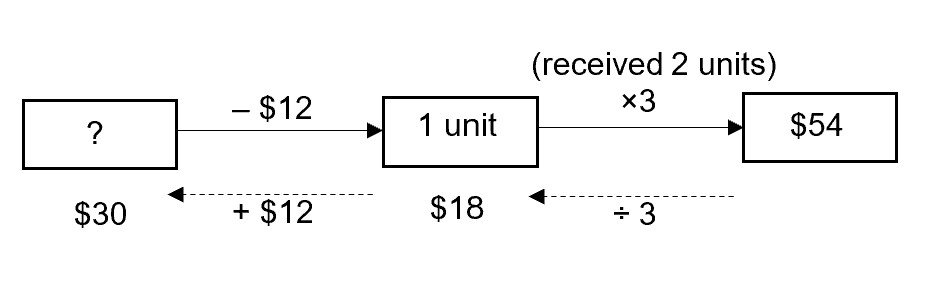
See that the final amount of $54 is made up of 3 units.
3 units = $54
1 unit = $54 ÷ 3 = $18
Amount at the start = $18 + $12 = $30 (ans)
7. Use Before-After Concept
What it involves:
This involves comparing a quantity before and after a change, often with bar models (or ratios) to show the difference or total. In many cases, we will need to look for what is changed and what remains unchanged (constant).
Sample Question and Application of Heuristic:
Mrs Goh is 45 years old and her nephew is 5 years old. In how many years’ time will Mrs Goh’s age be thrice her nephew’s age?
In the Before and After situations, students need to see that the age gap between any two persons will always be the same.
Age gap now between Mrs Goh and her nephew = 45 − 5 = 40 years
Future:
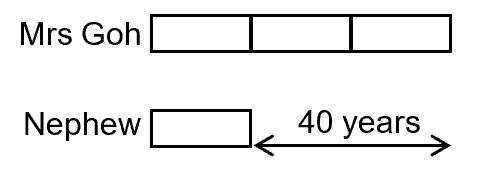
2 units = 40 yr
1 unit = 40 yr ÷ 2 = 20 yr
The nephew is 5 years old now. In the future, he will be 20 years old.
20 – 5 = 15 years’ time (ans)
8. Restate the Problem in Another Way
What it involves:
Rewriting the question in simpler or clearer terms helps in understanding what is being asked.
Sample Question and Application of Heuristic:
A packet of rice weighs 12 kg. Sally uses ⅕ of the packet of rice. How much rice is left? Express your answer in kilograms and grams.
This problem involves finding the leftover in fractions, which can confuse students. Restating it in simpler steps helps make the relationships clearer. This can also be done for students who prefer not to use the model method.
➡ Rephrase:
Instead of trying to process it all at once, rephrase it into parts:
- “She uses ⅕ of the rice” → She has 4/5 of her rice left.
Now the question becomes:
What is ⅘ of 12 kg?
5 units = 12 kg
1 unit = 12 ÷ 5 = 2.4 kg
4 units = 2.4 × 4 = 9.6kg = 9 kg 600 g (ans)
9. Simplify the Problem
What it involves:
Break a complex problem into simpler parts, or solve an easier version first.
Sample Question and Application of Heuristic:
A class of 40 students raised money for a charity event. Each student donated the same amount. Their total contribution was added the amount donated by the form and co−form teachers. The form and co−form teachers each donated $200. The total amount raised was $1560. What was the difference in amount donated by the form teacher and each student?
The question involves a combined total, but only part of it comes from students. To simplify, isolate the portion the students are responsible for before working out the individual amount.
How To Simplify the Problem:
1. Calculate the total amount donated by both teachers:
$200 × 2 = $400
2. Subtract the teacher contributions from the total amount raised:
$1560 − $400 = $1160
3. Divide by the number of students:
$1160 ÷ 40 = $29
4. Obtain difference:
$200 − $29 = $171 (ans)
10. Assumption
What it involves:
Temporarily assign a value to an unknown to test or simplify the problem.
Sample Question and Application of Heuristic:
There were 125 crystals to be used for making 25 pieces of necklaces and bracelets. A necklace will use up 8 crystals while a bracelet will use up 3 crystals. How many bracelets were made?
Assume all 25 pieces are necklaces. (Tip: always assume the item that is not required by the question)
Total no. of crystals to be used = 25 × 8 = 200
No. of crystals in excess = 200 – 125 = 75
To reduce the excess, we need to exchange some necklaces for bracelets.
When one necklace is removed, the total no. used crystals reduces by 8 and when replaced by one bracelet, the total no. of crystals used up will be increased by 3. So the overall reduction is 5.
Total no. of replacements = 75 ÷ 5 = 15
This means 15 necklaces are replaced by 15 bracelets.
So 15 bracelets were made. (ans)