
In this revision note, you will learn how to derive a number pattern formula so that you will be proficient in solving Number Pattern O-Level Math questions.
Number patterns are hidden all around us, and learning to identify and utilise them can unlock numerous benefits such as the prediction of outcomes and the forming of relationships between various objects and variables.
Building upon our earlier understanding of number sequences (learnt in primary school), we will learn in this chapter new types of sequences, tools to find their general formulas as well as their practical applications in everyday life.
Before you read on, you might want to download this entire revision notes in PDF format to print it out, or to read it later.
This will be delivered to your email inbox.

Number Pattern Definitions
Consider the following whole numbers:
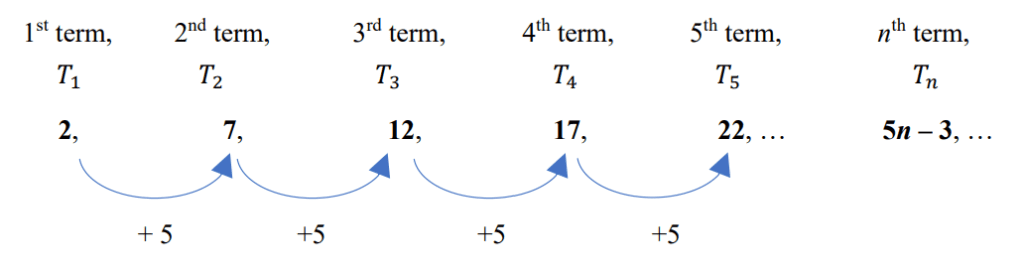
The above set of numbers 2, 7, 12, 17, 22, … forms a number sequence.
The numbers in the number sequence are called terms of the sequence. The 1st, 2nd, 3rd, 4th and 5th terms are 2, 7, 12, 17, and 22 respectively. We use T1 to represent the 1st term, T2 to represent the 2nd term, T3 to represent the 3rd term and so on.
The numbers in the number sequence are guided by a specific rule: begin with 2, then add 5 to the current term to obtain the next term.
The general term of the above number sequence, Tn , is represented by the algebraic expression 5n −3, where n is the ordinal numerical value of the term. For instance, to obtain the 100th term in the number sequence above, we let n = 100, then T100 = 5(100) − 3 = 497.
Hence the general term, Tn = 5 − 3, is a number pattern formula to enable us to accurately predict any term in the sequence without having to list out all the previous terms (1st to 99th).
Obtaining the Number Pattern Formula
To obtain the number pattern formula of a number sequence, you need to apply some key skills below:
1. Identifying patterns: This is the most crucial skill. You need to observe and analyze the sequence to identify the underlying pattern that governs the change from one term to the next. This can involve looking for constant differences, ratios, or other recurring features.
2. Understanding different types of sequences: Familiarity with various types of sequences, such as arithmetic, geometric, quadratic, and Fibonacci, is essential. Each type has its specific pattern and formula for generating the terms.
3. Applying mathematical concepts: You need to apply mathematical concepts like arithmetic operations, powers of numbers, and even algebra to express the pattern in a mathematical form.
4. Inductive reasoning: You need to generalise the observed patterns to form a rule that applies to all terms in the sequence, including those not explicitly given.
5. Translating patterns into formulas: Once you have identified the pattern and rule, you need to translate it into a concise and accurate formula using mathematical notation.
6. Checking and verifying: It’s crucial to verify your formula by testing it on several terms in the sequence and ensuring it accurately predicts the values.
The above steps can be demonstrated in the given number sequence:
2, 7, 12, 17, 22, …
Steps |
Actions To Take |
|
1. Identifying patterns |
Observe that the numbers are increasing. The numbers are increasing by a constant amount of 5. |
| 2. Understanding different types of sequences |
Based on the above initial observations, this is an arithmetic sequence. [We will learn more about this type of sequence and other sequences in later part of the notes.] |
| 3. Applying mathematical concepts | Increasing by 5 is the same as +5. |
| 4. Inductive reasoning |
We can represent each term of the number sequence as follows: T1 = 2 T2 = 2 + 5 T3 = 2 + 5 + 5 T4 = 2 + 5 + 5 + 5 T5 = 2 + 5 + 5 + 5 + 5 |
| 5. Translating patterns into formulas |
Observe that the pattern always begin with 2, and we progressively add 5 to the current term to obtain the next one. The number of 5s in the current term is always one less than the ordinal numerical value. For instance, we add one 5 to the 2nd term, we add two 5s to the 3rd term, we add three 5s to the 4th term and so on. Therefore, to obtain the nth term, we begin with 2 and then we add (n – 1) number of 5s. This translates to: Tn = 2 + (n – 1)5 = 5n – 3 |
| 6. Checking and verifying |
Once we have the general term Tn = 5n – 3, we must check that the formula can indeed give us all the correct terms. We progressively substitute n with 1, 2 and 3, into the formula and cross check with the given terms in the number sequence. T1 = 5(1) – 3 = 2 [✔] T2 = 5(2) – 3 = 7 [✔] T3 = 5(3) – 3 = 12 [✔] Check for at least the first 3 terms to be sure that we have the correct formula. |
Number Pattern Formula of Different Sequences
Arithmetic Sequences
An arithmetic sequence (also known as a linear sequence) is a sequence of numbers where the difference between any two consecutive terms is constant. This constant difference, d, is called the common difference.
Number Pattern Formula for Arithmetic Sequences: Tn = a + (n – 1)d
where n is the ordinal numerical value of the term, a is the first term and d is the common difference between any two consecutive terms.
Examples:
- 1, 4, 7, 10, 13, 16, … (a = 1, d = 3)
- 20, 15, 10, 5, 0, −5, … (a = 20, d = −5)
Applications to real life:
- Finance: calculating loan payments with constant interest rate
- Statistics: analysing data trends and forecasting future values
Arithmetic Sequences Example
A certain number sequence is given as:
3, 7, 11, 15, …
(a) Write down the next two terms of the sequence.
(b) Write down an expression ,in terms of n, for the nth term of the sequence.
(c) Hence
(i) find the 45th term of the number sequence.
(ii) determine if 400 is in the number sequence.
Solution:
(a) 19, 23
(b) Tn = 3 + (n − 1)(4)
= 4n − 1
(c)(i) T45 = 4(45) − 1 = 179
(ii) Assume 400 is in the number sequence. Then Tn = 400 for a positive integer n.
4n − 1 = 400
4n = 399
n = 99.75 (not a positive integer)
Since n is not a positive integer for Tn = 400, 400 is not in the number sequence.
Geometric Sequences
A geometric sequence is a sequence of numbers where each term is obtained by multiplying the previous term by a constant value. This constant value is called the common ratio, r.
Number Pattern Formula for Geometric Sequence: Tn = arn–1,
where n is the ordinal numerical value of the term, a is the first term and r is the common ratio between any two consecutive terms.
Examples:
- 2, 6, 18, 54, 162, 486, … (a = 2, r = 3)
- 1000, 100, 10, 1, 0.1, 0.01, … (a = 1000, r = 0.1)
- 3, −6, 12, −24, 48, −96, … (a = 3, r = −2)
Applications to real life:
- Finance: analysing compound interest rates, inflation etc
- Biology: understanding rate of cell division, rate of disease transmission etc
- Physics: modelling the decay of a radioactive substance
Geometric Sequences Example
A certain number sequence is given as:
4, 20, 100, 500, …
(a) Write down the next two terms of the sequence.
(b) Write down an expression ,in terms of n, for the nth term of the sequence.
(c) Hence
(i) find the 20th term of the number sequence, giving your answer in standard form.
(ii) explain why the difference between any two consecutive terms is always exactly divisible by 2.
Solution:
(a) 2 500, 12 500
(b) Tn = 4(5)n – 1
(c)(i) T20 = 4(5)20−1 = 7.63 × 10¹³
(ii) Tn+1 − Tn = 4(5)n+1 − 4(5)n
= 4(5 n+1 − 5n)
= (2)(2)(5n+1 − 5n)
Since the difference between any two consecutive terms is a multiple of 2, the difference is always exactly divisibly by 2.
Harmonic Sequences
A harmonic sequence is a sequence of numbers where each term is the reciprocal of the corresponding term in an arithmetic sequence. In simple terms, it’s a sequence of reciprocals of an arithmetic sequence.
Number Pattern Formula for Harmonic Sequences: Tn =1/ (a+(n−1)d),
where n is the ordinal numerical value of the term, a is the denominator of the first term, and d is the common difference between the denominators of any two consecutive terms.
Examples:
- Arithmetic sequence: 1, 4, 7, 10, 13, 16, …
Harmonic sequence: 1, 1/4, 1/7, 1/10, 1/13, 1/16, … (a = 1, d = 3)
- Arithmetic sequence: 1, 3/2, 2, 5/2, 3, 7/2, 4, …
Harmonic sequence: 1, 2/3, 1/2, 2/5, 1/3, 2/7, 1/4, … (a = 1, d =1/2)
Applications to real life:
- Physics: modeling the motion of a falling object
- Probability Theory: calculating the probability of certain events occurring in a series of trials
Square Numbers
A square number is a positive integer obtained by squaring an integer. In simpler terms, it’s the product of a number multiplied by itself.
For example, the sequence 1, 4, 9, 16, 25,… is a sequence of square numbers.
Number Pattern Formula for Square Numbers: Tn = n2,
where n is the ordinal numerical value of the term.
- A sequence of square number can be geometrically represented as follows:

- A sequence of square numbers can also be geometrically represented as triangular stacks as follows:
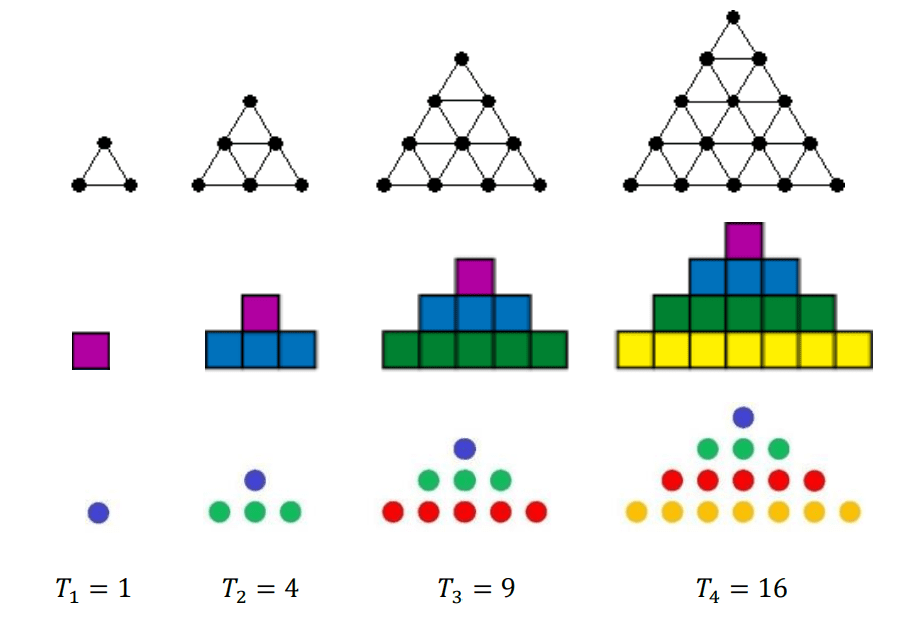
As a result, we can also rewrite each square number as a sum of the number of objects in
each row:
T1 =1
T2= 1+ 3 = 4
T3 = 1+ 3+ 5 = 9
T4 = 1 +3 + 5 + 7 = 16
Applications to real life:
- Geometry: Determining areas and volumes squares, rectangles and other other geometric shapes.
- Cryptography: Used in encryption algorithms for secure communication.
Sequence of Triangular Numbers
A triangular number is a positive integer that represents the number of objects arranged in an equilateral or right-angled isosceles triangle.
Each additional row adds one more object than the previous row, creating a triangular shape, like the examples shown below.

Hence, the sequence 1, 3, 6, 10, 15, 21,… is a sequence of triangular numbers. We can also rewrite each triangular number as a sum of the number of objects that form the triangle:
T1 = 1
T2 = 1 + 2 = 3
T3 = 1 + 2 + 3 = 6
T4 = 1 + 2 + 3 + 4 = 10
T5 = 1 + 2 + 3 + 4 + 5 = 15
T6 =1 + 2 + 3 + 4 + 5 + 6 = 21
Number Pattern Formula for Triangular Numbers: Tn =n(n + 1)/2,
where n is the ordinal numerical value of the term.
Applications to real life:
Geometry: calculating areas and volumes of certain shapes.
- Combinatorics: counting the number of ways to choose k objects from a set of n objects.
Fibonacci Sequence
The Fibonacci sequence is a sequence of numbers where each number is the sum of the two preceding ones. Starting with 0 and 1, the sequence continues:
0, 1, 1, 2, 3, 5, 8, 13, 21, 34, 55, 89, …
Number Pattern Formula for Fibonacci Sequence: Tn = Tn –1 + Tn – 2,
where n is the ordinal numerical value of the term.
Unique Properties:
- The sequence grows rapidly, with each number being significantly larger than the previous one.
- The ratio of consecutive Fibonacci numbers approaches the golden ratio, φ (approximately 1.618) as the sequence progresses.
- Squares with side lengths of consecutive Fibonacci numbers: Draw squares with side lengths of consecutive Fibonacci numbers (1, 1, 2, 3, 5, etc.) and connect their opposite corners with quarter-circle arcs. As you continue this process, the arcs will form a beautiful spiral shape. This pattern can be continued indefinitely.

Applications to real life:
- Art and design: The golden ratio and Fibonacci sequence are used in various artistic and design forms to create aesthetically pleasing compositions.
- Nature and biology: In the natural world, the Fibonacci sequence repeats itself: in the way flower petals are attached to a stalk, branches grow from a tree, bracts are arranged on a pine cone and leaves are arranged on a stem. Hence it is said to be considered to be lucky to be able to find a 4-leaf clover.
Last Minute Revision for O Level Math?
Check out our exam guide on other topics here!
Before you go, you might want to download this entire revision notes in PDF format to print it out, or to read it later.
This will be delivered to your email inbox.
Does your child need help with Mathematics? Find out more about our Math Tuition Class Free Trial.
1) Live Zoom Lessons at Grade Solution Learning Centre

At Grade Solution Learning Centre, we are a team of dedicated educators whose mission is to guide your child to academic success. Here are the services we provide:
– Live Zoom lessons
– EdaptIQ™, a smart learning platform that tracks your child’s progress, strengths and weaknesses through personalised digital worksheets.
– 24/7 Homework Helper Service
We provide all these services above at a very affordable monthly fee to allow as many students as possible to access such learning opportunities. We also offer a free trial class and consultation with our tutors, to help make sure we are the best fit for your child.
We specialise in English, Math, and Science subjects.
You can see our fees and schedules here >>
2) Pre-recorded Online courses on Jimmymaths.com

If you are looking for something that fits your budget, or prefer your child learn at his or her own pace, you can join our pre-recorded online Math courses.
Your child can:
– Learn from recorded videos
– Get access to lots of common exam questions to ensure sufficient practice
– Get unlimited support and homework help
You can see the available courses here >>