Binomial Theorem Formula Explained: A-Math Exam Preparation Guide 2025
What is the Binomial Theorem?
The Binomial Theorem is a handy formula in algebra that helps us expand expressions like (x + y)n without having to multiply everything out by hand. It takes a binomial (an expression with two terms) raised to a power and breaks it down into a series of simpler terms that we can add together.
Before you read on, you might want to download this entire revision notes in PDF format to print it out, or to read it later.
This will be delivered to your email inbox.
Binomial Theorem Formula & Explanation
The Binomial Theorem is a tough topic for many students taking A-Math. The binomial expansion formula is crucial for expanding expressions raised to any finite power. In these notes, we will go through the Binomial Theorem, important notations and formulas, as well as explain how they work.
You will learn the following:
The Notation n!
The Notation “n Choose r” i.e. (nCr)
Pascal’s Triangle
The Binomial Theorem Expansion & Binomial Formula
The General Term
The Notation n!
The notation n! denotes the factorial of a positive integer n. For a positive integer n, n! = n × (n − 1) × (n – 2) × (n – 3) × … × 3 × 2 × 1.
Note that 0! = 1 (not 0).
For instance, 4! = 4 × 3 × 2 × 1.
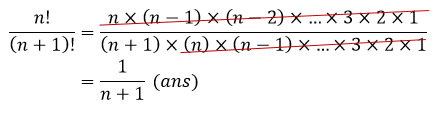
Example of n!
Simplify
Solution:
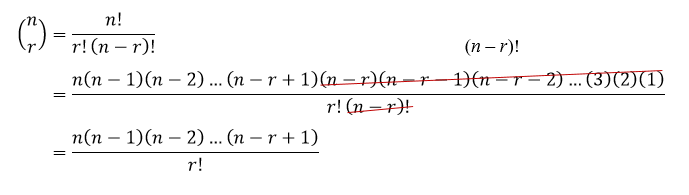
The Notation (nCr)
The notation (nCr) is read as ‘n choose r’. For integers n and r, and 0 ≤ r ≤ n,
Pascal’s Triangle
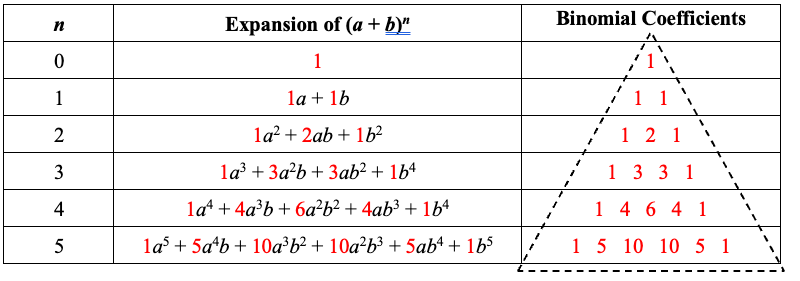
The table below shows the pattern between the binomial expansion (a + b)n and the binomial coefficients.
The triangular array of binomial coefficients is called Pascal’s Triangle. Each row must begin and end with a 1. The other coefficients can be obtained by adding the two coefficients immediately above it. The next row for n = 6 would hence be
1 (5 + 1) (5 + 10) (10 + 10) (10 + 5) (5 + 1) 1
⇒ 1 6 15 20 15 6 1
Example of Pascal’s Triangle
(i) Use Pascal’s Triangle to find the first five terms, in ascending powers of b, in the expansion of (1 + b)7.
(ii) Hence deduce the first five terms, in ascending powers of x, in the expansion of (1 − 2x)7.
Solution (i) Replacing a with 1: Observe that (1 + b)n = 1 + Ab + Bb2 + … + bn, where A, B, … are binomial coefficients, and that the powers of b increase from 0 to n.
Using Pascal’s Triangle, For n = 6, the binomial coefficients are as follow: 1 6 15 20 15 6 1 For n = 7, the binomial coefficients are as follow: 1 7 21 35 35 21 7 1
Adding increasing powers of b to the binomial coefficients,
As you have learnt form the Pascal’s Triangle, each binomial coefficient in Pascal’s Triangle can be represented by the notation (nCr).
Note that r always begins with 0.
As such, the number of terms in a binomial expansion of x, would be x + 1. Meaning, the number of terms is always 1 more than the value of the power, x
Binomial Theorem Expansion Formula
Binomial expansion formulas are essential for expanding expressions of the form (a + b)n.
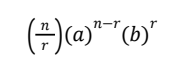
For a positive integer n, the general form of the binomial theorem expansion for (a + b)n is
You can observe that: (i) r is also an integer such that 0 ≤ r ≤ n, (ii) the powers of a and b for each term will always sum up to n, (iii) the powers of a will decrease and the powers of b will increase (hence, switching the positions of a and b will result in decreasing powers of b and increasing powers of a). This will be very useful if the question requires you to expand in descending powers.
Example of Binomial Theorem Expansion
(i) Write down the first four terms in the expansion of (2 – x)7 in ascending powers of x. (ii) Hence estimate the value of 1.987 correct to 3 decimal places. (iii) The coefficient of x2 in the expansion of (a – x)(2 – x)7 is 3136. Find the value of the constant a.
Solution: (i)
(ii) (1.98)7=(2 – 0.02)7 Replacing x with 0.02,
(iii)
Coefficient of x2: 672a + (-1)(-448) = 3136
672a = 2688
a = 4 (ans)
The General Term (Tr+1)
Recall there are n + 1 number of terms in a binomial expansion (a + b)n.
If you want to find a specific term, do you always have to start expanding from the first term to find the specific term you want?
Of course not!
You can obtain any specific term in the expansion by working with the general term (Tr+1).
The general term Tr+1 in the expansion of (a + b)n is
The term independent of any variable can be found using the general term formula.
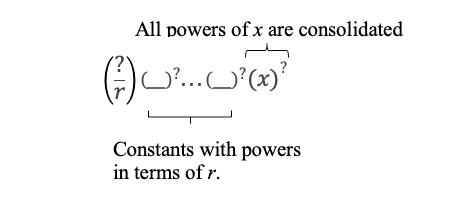
After writing out the general term, simplify it and consolidate powers of x. In other words, the general term should look like this:
** Proficiency in the laws of indices is necessary to simplify the general term.
Example of the General Term
From the expansion of (x3 – 2/x2)10, find (i) the term in x10, (ii) the coefficient of 1/x5 ,
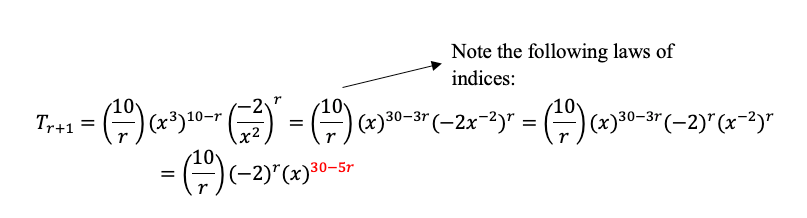
Solution:
(i) For the term in x10, let 30 – 5r = 10
5r = 20
r = 4
When r = 4,
(ii)
1/x5 = x-5
For the term in x-5, let 30 – 5r = −5. 5r = 35
r = 7
When r = 7, coefficient of x−5 is (10/7) (-2)7= -15360 (ans)
Using the Binomial Theorem in A-Maths
With the help of this guide, you can work out how to carry out binomial theorem expansion and easily solve questions in A-Maths! To learn more about the various subjects we cover, click here to find out more about our A-Maths tuition options, or check out our A-Maths revision notes.
Before you go, you might want to download this entire revision notes in PDF format to print it out, or to read it later.
This will be delivered to your email inbox.
Does your child need help with Mathematics? Find out more about our Math Tuition Class Free Trial.
1) Live Zoom Lessons at Grade Solution Learning Centre
At Grade Solution Learning Centre, we are a team of dedicated educators whose mission is to guide your child to academic success. Here are the services we provide:
– Live Zoom lessons
– Adaptably, a smart learning platform that tracks your child’s progress, strengths and weaknesses through personalised digital questions.
– 24/7 Homework Helper Service
We provide all these services above at a very affordable monthly fee to allow as many students as possible to access such learning opportunities. We also offer a free trial class and consultation with our tutors, to help make sure we are the best fit for your child.
We specialise in English, Math, and Science subjects.
If you are looking for something that fits your budget, or prefer your child learn at his or her own pace, you can join our pre-recorded online Math courses.
Your child can:
– Learn from recorded videos
– Get access to lots of common exam questions to ensure sufficient practice