Average Formula: How to Find Average & Use an Average Function to Find Unknowns

The main aim of this math revision note is to help your child become better at visualising word problems that involve how to find the average and use the average concept to find the unknowns. With a clearer visualisation and hence better understanding of the question, your child can become more proficient in solving this kind of challenging average questions.
The main aim of this math revision note is to help your child become better at visualizing word problems that involve central tendency concepts like how to find the average number and use the average formula to find unknowns. With a clearer visualization and hence better understanding of the question, your child can become more proficient in solving this kind of challenging average question.
First, let’s do a recap on:
This is a representation of the arithmetic mean, another term for average. It is often used when we want to determine the average value of a dataset by considering all the data, including problem sums with zero values.
The average/mean should not be confused with the term median, which refers to the middle number in a set of numbers.
Before you read on, you might want to download this entire revision notes in PDF format to print it out for your child, or to read it later.
This will be delivered to your email inbox.
The average height of a group of children was 133.3 cm.
When Mr Wong measured and recorded the height of these children, he mistakenly recorded one child’s height as 183 cm when it should have been 138 cm. As a result, Mr Wong calculated the average height as 142.3 cm.
How many children were there in the group?

Before starting to solve the question, we can lay out all the elements of the questions in the following manner
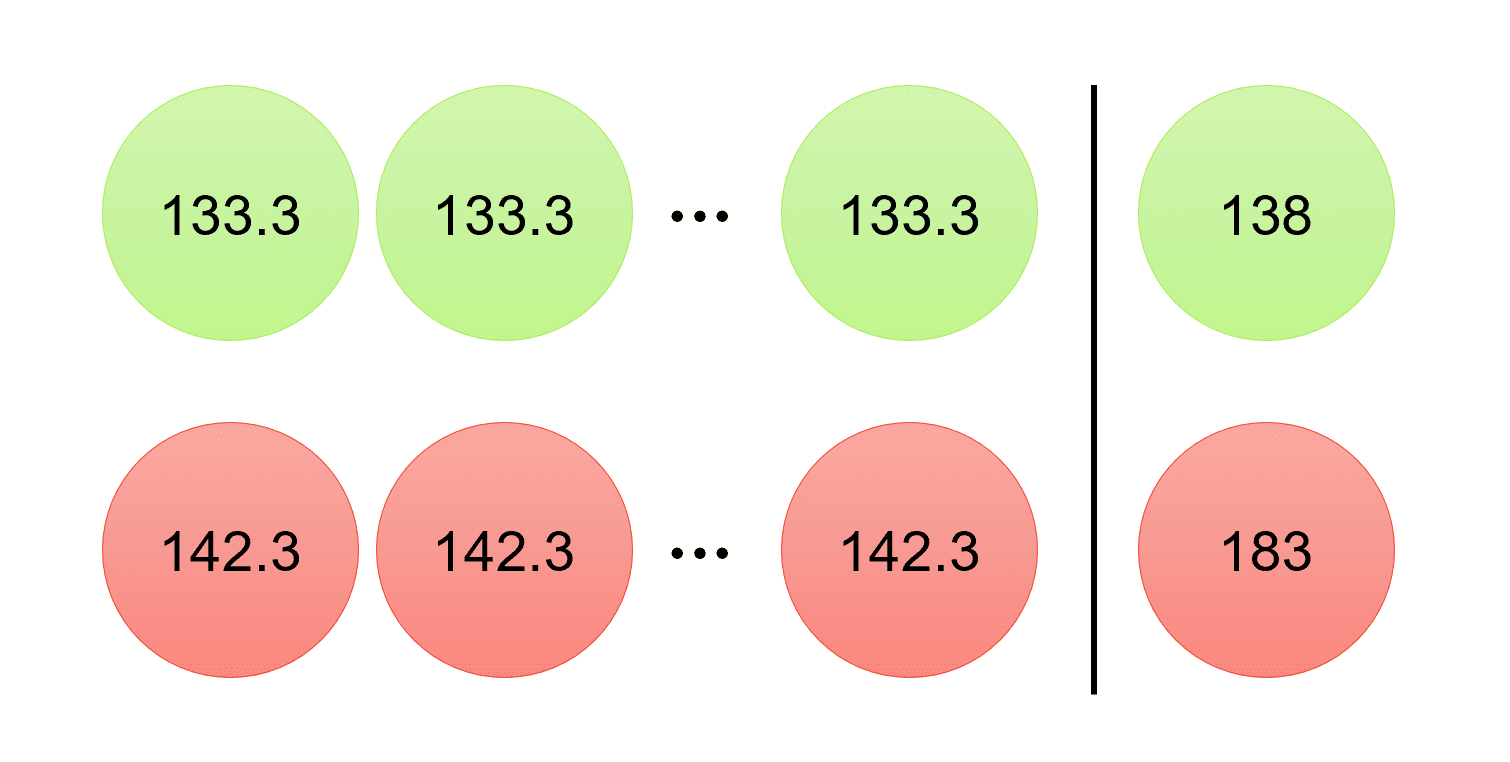
The top row of number discs represents the correct values while the bottom row of discs represents the wrong values.
On the left side of the black line, we see the averages – with the top row being the correct averages while the bottom row being the wrong averages.
The number of discs on the left in each row represents the number of children in the group. This graphic on the left in each row essentially is showing us the following equation:

On the right side of the black line, we can isolate the height of the particular child with the top number disc being the correct height while the bottom disc being the wrong height.
The height that Mr Wong recorded for the child is more than the actual height. Since a larger value was recorded, it makes sense that the wrong average calculated is larger than the actual average.
183 cm – 138 cm = 45 cm
The height that Mr Wong recorded is 45 cm more than the actual height.
This 45 cm increase will contribute to the increase in the total height.

This increase in total height will be split among the individual increases in each set of averages. We can find this individual increase by the averages given in the question.
142.3 cm – 133.3 cm = 9 cm
Each average increased by 9 cm.

Each individual increase = 9
All these individual increases (as shown in the +9 arrows) will collectively become a total increase of 45.
To find out how many increases/arrows, we simply take 45 divided by 9.
45 cm ÷ 9 cm
= 5 children (Ans)
This number of increases/arrows also represents the number of children there are in the group.
To check if your answer is correct, you can substitute the answer back into the question to check if it makes sense.
Correct Total = 133.3 x 5 = 666.5
Wrong Total = 142.3 x 5 = 711.5
Difference in totals = 711.5 − 666.5 = 45
This is the same difference as the difference between the 2 wrong datas (138 and 183).
Hence, your answer is correct. 🙂
Averages are an extremely common concept in mathematics, and making use of these formulas can help your child visualise word problems and solve a wide variety of questions.
Before you go, you might want to download this entire revision notes in PDF format to print it out for your child, or to read it later.
This will be delivered to your email inbox.
1) Live Zoom Lessons at Grade Solution Learning Centre
At Grade Solution Learning Centre, we are a team of dedicated educators whose mission is to guide your child to academic success. Here are the services we provide:
– Live Zoom lessons
– Adaptably™, an innovative smart learning platform featuring thousands of PSLE and exam-based questions tailored for your child’s practice. Adaptably not only tracks your child’s progress but also identifies their strengths and areas for improvement, providing valuable insights to enhance their learning journey.
– 24/7 Homework Helper Service
We provide all these services above at a very affordable monthly fee to allow as many students as possible to access such learning opportunities.
We specialise in English, Math, Science and Chinese subjects.
You can see our fees and schedules here >>
2) Pre-recorded Online courses on Jimmymaths.com

If you are looking for something that fits your budget, or prefer your child learn at his or her own pace, you can join our pre-recorded online Math courses.
Your child can:
– Learn from recorded videos
– Get access to lots of common exam questions to ensure sufficient practice
– Get unlimited support and homework help
You can see the available courses here >>