15 Common Types of P5 Math Questions

Struggling to figure out what types of Math questions your child needs to master in Primary 5?

You’re not alone. P5 is a crucial year where the jump in difficulty often catches students off guard, especially in problem sums.

In this article, we break down 15 common types of P5 Math questions that appear frequently in exams, so you’ll know exactly where to focus your child’s practice and build their confidence step by step.

Let’s dive in!
Before you read on, you might want to download this entire revision notes in PDF format to print it out, or to read it later.
This will be delivered to your email inbox.

secondary math revision notes


Q1. Lowest Common Multiple (LCM)

At a bus interchange, Bus X arrives every 15 minutes and Bus Y arrives every 21 minutes. If both buses arrive together at the interchange at 10:30 a.m., what is the next earliest time they will arrive together again? Express your answer in 12-hour format.

Solution:
Multiples of 15: 15, 30, 45, 60, 75, 90, 105, …
Multiples of 21: 21, 42, 63, 84, 105, …

The LCM of 15 and 21 is 105. The buses will arrive together at 105-minute intervals.

105 min = 1 h 45 min
1 h 45 min from 10:30 am is 12:15pm (ans)

Q2. Highest Common Factor (HCF)

Mrs Lee needs to pack identical goodie bags using 36 markers, 60 highlighters and 84 stickers.

(a) What is the greatest number of goodie bags she can pack if each bag must contain the same number of markers, highlighters, and stickers with none left over?

(a) How many of each item will be in one goodie bag?

Solution:
(a)
Factors of 36: 1, 2, 3, 4, 6, 9, 12, 18, 36
Factors of 60: 1, 2, 3, 4, 5, 6, 10, 12, 15, 20, 30, 60
Factors of 84: 1, 2, 3, 4, 6, 7, 12, 14, 21, 28, 42, 84

HCF of 36, 60 and 84 is 12.
The greatest number of identical goodie bags she can pack is 12. (ans)


(b)
36 ÷ 12 = 3
60 ÷ 12 = 5
84 ÷ 12 = 7

Each goodie bag contains 3 markers, 5 highlighters and 7 stickers. (ans)

Q3. Rounding Off

A whole number rounds to 46 000 when rounded to the nearest thousand. What is the smallest and largest possible value it could be?

Solution:
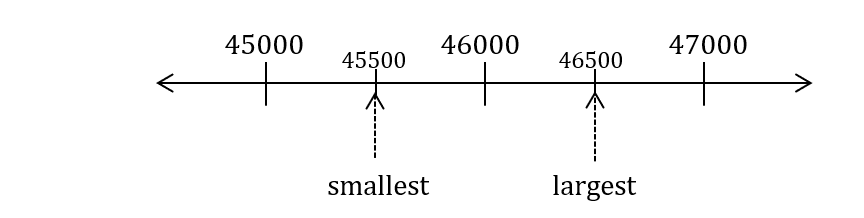
Since the method of rounding is to the nearest thousand, make a number line 1-thousand intervals. Write the rounded off value in the centre, and the adjacent thousand on its left and right: 45000 and 47000.

We then identify the midpoints:
• Halfway between 45,000 and 46,000 is 45,500
• Halfway between 46,000 and 47,000 is 46,500

The smallest possible value that rounds to 46000 is 45500, since anything less than that would round to 45,000.

The largest possible value is just before 46500, because 46500 would round up to 47,000. So, the largest value is: 46,500 – 1 = 46,499

Ans: 45500 (smallest), 46499 (largest)

Q4. Excess and Shortage (unfixed containers)

A fruit seller has some apples. If he packs 4 apples into a bag, he will have 2 apples left. If he packs 7 apples into a bag, he will be short of 2 apples. What is the smallest possible number of apples the fruit seller has?

Solution:
Depending on the packing method, the final number of bags will be different.
By Listing Method, we have the following.

4 apples in a bag 7 apples in a bag
4 × 1 bag + 2 left over = 6 apples
4 × 2 bags + 2 left over = 10 apples
4 × 3 bags + 2 left over = 14 apples

4 × 13 bags + 2 left over = 54 apples
7 × 1 bag – 2 short = 5 apples
7 × 2 bags – 2 short = 12 apples
7 × 3 bags – 2 short = 19 apples

7 × 8 bags – 2 short = 54 apples

Ans: 54 apples

Q5. Excess and Shortage (fixed containers)

Mrs Devi bought some pencils for her pupils. If she gives 7 pencils to each pupil, there will be 35 pencils left. If she gives 5 pencils to each pupil, there will be 105 pencils left. How many pupils are there in Mrs Devi’s class?

Solution:
The number of pupils in the class is fixed, regardless of the number of pencils each pupil receives.

After giving 5 pencils to each pupil, there is a leftover of 105.

Each pupil already has 5 pencils. To give 7 pencils to each pupil, each pupil takes 2 more from the leftover of 105. And there is a final remainder of 35.

When each pupil takes 2 pencils, 105 – 35 = 70 pencils are given out.

Total no. of pupils = 70 ÷ 2 = 35 (ans)

This question can also be solved using Listing Method from Q4 but it will take more time.

5 pencils for each pupil 7 pencils for each pupil
5 × 1 pupil + 105 left over = 110 pencils
5 × 2 pupils + 105 left over = 115 pencils
5 × 3 pupils + 105 left over = 120 pencils

5 × 35 pupils + 105 left over = 280 pencils
7 × 1 pupil + 35 left over = 42 pencils
7 × 2 pupils + 35 left over = 49 pencils
7 × 3 pupils + 35 left over = 56 pencils

7 × 35 pupils + 35 left over = 280 pencils

Ans: 35 pupils

Q6. Number Pattern [sorting into columns]

In the table below, a whole number will appear in either Column W, X, Y or Z.

W X Y Z
    1 2
6 5 4 3
7 8 9 10
14 13 12 11

In which column will the number 111 appear?

Solution:
See that each number corresponds to a letter:
1 → Y
2 → Z
3 → Z
4 → Y
5 → X

Pattern: Y, Z, Z, Y, X, W, W, X, Y, Z, Z, Y, X, W, W, X, Y, Z, Z, Y, X, W, W, X, …
8 letters: Y, Z, Z, Y, X, W, W, X, form a complete group.
111 ÷ 8 = 13 complete groups and 7 leftover letters [Y, Z, Z, Y, X, W, W]

The 111th letter corresponds to W.

Q7. Replacement (Same Total Expressed in Different Units)

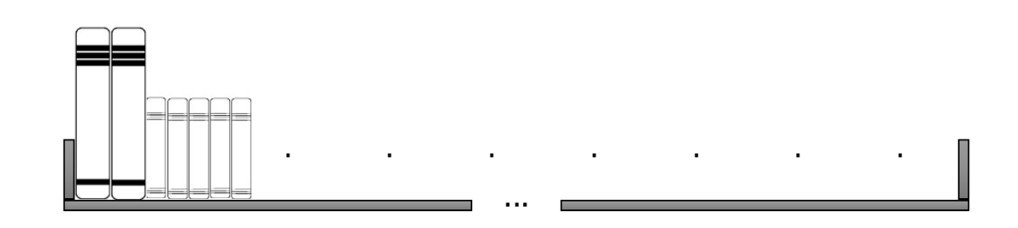
The bookshelf shown below can be filled from end to end with 18 large books or 45 small books.

There are 2 large books and 5 small books on the bookshelf. How many more large books can be put on the bookshelf?

Solution:
Method 1 (Replace the small books by large books):

The amount of space taken up by 18 large books is equivalent to the amount of space taken up by 45 small books.

18 Large → 45 Small
2 Large → 5 Small
Original amount of space → 18 Large books.
Amount of space left → 18 Large books – 2 Large books – 5 Small books
= 18 Large books – 2 Large books – 2 Large books
= 14 Large books (ans)

Method 2 (Expressing different units into another common unit):

18 : 45 = 2 : 5
The large book takes up 5 units of space while the small book takes up 2 units of space.
Total amount of space = 18 large books × 5 units of space = 90 units
Amount of space already taken up
= 2 large books × 5 units + 5 small books × 2 units
= 20 units

Amount of space left = 90 units – 20 units = 70 units

No. of large books required to fill up 70 units of space = 70 units ÷ 5 units = 14 (ans)

Q8. Grouping

A bakery has the following promotion for cupcakes:

Betty has $110. What is the maximum number of cupcakes she can get from the bakery?

Solution:
Cost of 6 cupcakes = 6 × $2.50 = $15

Making a group, we have the following.

1 group cost $15.

6 cupcakes (paid) + 1 cupcake (free) = 7 cupcakes

Maximum no. of groups that can be bought with $110 = $110 ÷ $15 = 7 groups R $5

With the remaining $5, Betty can buy another $5 ÷ $2.50 = 2 cupcakes.

Total number of cupcakes in 7 groups = 7 × 7 = 49

Total number of cupcakes Betty can get = 49 + 2 = 51 (ans)

Q9. Assumption

There were 125 crystals to be used for making 25 pieces of necklaces and bracelets. A necklace will use up 8 crystals while a bracelet will use up 3 crystals. How many bracelets were made?

Solution:
Assume all 25 pieces are necklaces. (Tip: always assume the item that is not required by the question)

Total no. of crystals to be used = 25 × 8 = 200

No. of crystals in excess = 200 – 125 = 75

To reduce the excess, we need to exchange some necklaces for bracelets.

When one necklace is removed, the total no. used crystals reduces by 8 and when replaced by one bracelet, the total no. of crystals used up will be increased by 3.

So the difference is 8 – 3 = 5.

Number of bracelets (Opposite) = 75 ÷ 5 = 15

This means 15 necklaces are replaced by 15 bracelets.

Ans: 15 bracelets were made.

Q10. Sharing of Time

A group of 6 pupils booked 3 computers in the library for online research from 1:30 p.m. to 4:00 p.m. At all times, all 3 computers were in use. If each pupil spent the same amount of time on a computer, how many minutes did each pupil spend researching online?

Solution:
Duration of booking from 1:30pm to 4:00pm = 2 h 30 min = 150 min
Total amount of available time provided by 3 computers = 3 × 150 min = 450 min
Amount of time spent by each pupil
= 450 min ÷ 6
= 75 min (ans)

Q11. Fraction of a Quantity

This refers to part of a given amount, usually obtained by multiplying a fraction with a whole number.

For example: “What is 3/4 of 20?”
This is asking for a fraction of a quantity → 3/4 × 20 =15

It is an operation (usually multiplication) — taking a portion of something.

Question:

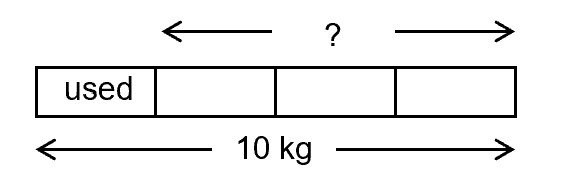
A packet of rice weighs 10 kg. A family uses  1/4  of the packet of rice. How much rice is left? Express your answer in kilograms and grams.

Method 1 (Part of a whole):

Fraction of rice that is left = 1 – 1/4 = 3/4
3/4 × 10 kg = 7.5 kg

Method 2 (Model Drawing):

4 units → 10 kg
1 unit → 10 kg ÷ 4 = 2.5 kg
3 units → 2.5 kg × 3 = 7.5 kg
                                   = 7 kg 500 g (ans)

 Q12. Fractional Quantity

This refers to a quantity (or measurement) that is itself a fraction, not a whole number.

For example: “The bottle contains 1  1/2 ℓ of juice.”

It means the value is not entirely a whole number — it includes a fractional part, which is  1/2  .

It is a description — stating that a value (or measurement) is a fraction or mixed number.

Question:

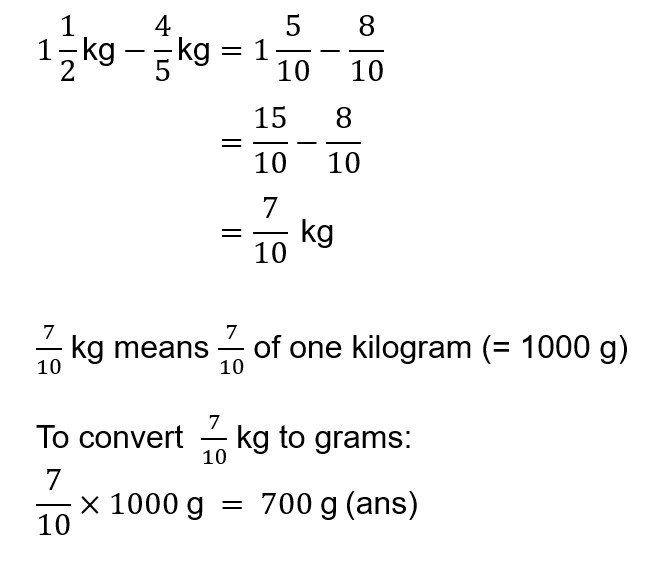
Mrs Lee bought 1  1/2  kg of rice. She used 4/5  kg  of it. What was the mass of rice left? Express your answer in grams.

Solution:

Q13. Part of a Remainder

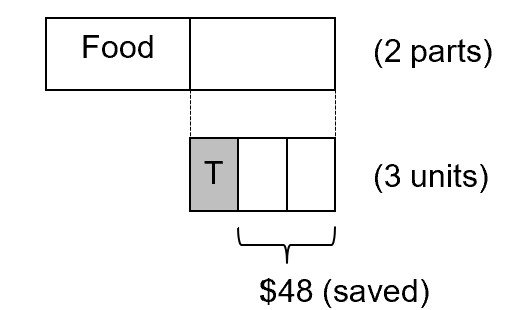
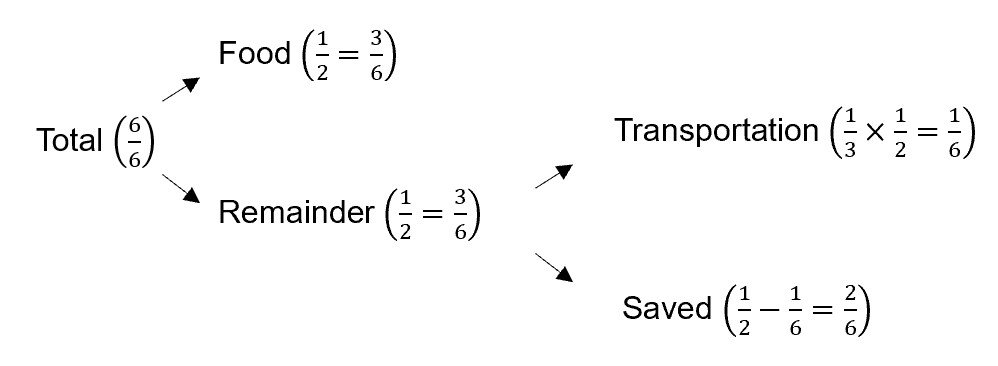
Lifen spent 1/2 of her weekly allowance on food, 1/3 of the remainder on transportation and saved the rest. If she saved $48, how much was Lifen’s weekly allowance?

Solution:
Method 1 (Model Drawing):

2 units → $48
1 unit → $48 ÷ 2 = $24
3 units → $24 × 3 = $72
1 part → $72
2 parts → $72 × 2 = $144 (ans)

Method 2 (Branching):

2/6  of total  → $48
1/6  of total → $48 ÷ 2 = $24
6/6  of total  → $24 × 6 = $144 (ans)

Q14. Constant Difference

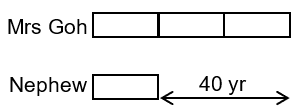
Mrs Goh is 45 years old and her nephew is 5 years old. In how many years’ time will Mrs Goh’s age be thrice her nephew’s age?

Solution:
The age gap between any 2 persons will always be the same.
Age gap between Mrs Goh and her nephew = 45 − 5 = 40 years

Future:

2 units → 40 yr
1 unit → 40 yr ÷ 2 = 20 yr

The nephew is 5 years old now. In the future, he will be 20 years old.
Ans: 20 – 5 = 15 years’ time

Q15. Constant Total

Aiden had  1/5  as much money as his sister. When his sister gave him $50, Aiden then had  1/2  as much money as his sister. How much money did Aiden and his sister have together?

Solution:

Before: 1 + 5 = 6 units. After: 1 + 2 = 3 units.

Even though the number of units before and after the transfer are different, the value of the 6 units is the same as the value of the 3 units. We adjust the units so both ‘before’ and ‘after’ totals match in value.

*The no. of units are different because the unit sizes before and after are different.

The LCM of 6 and 3 is 6. So we write 1/2  as  2/4 .  After the transfer, Aiden then has 2 units and the sister has 4 units. See that 2 units + 4 units = 6 units, which is the original total number of units.

Before:

Aiden → 1 unit
Sister → 5 units

After:

Aiden → 2 unit
Sister → 4 units

The increase in 1 unit must represent the $50 that was given to him by the sister. Also see that the number of units for the sister decreased by 1 unit.

1 unit → $50
6 units → $300 (ans)

Before you go, you might want to download this entire revision notes in PDF format to print it out, or to read it later. 

This will be delivered to your email inbox.


secondary math revision notes


Does your child need more help?

Find out more about our Math Tuition Class.

1) Live Zoom Lessons at Grade Solution Learning Centre

Grade Solution Learning Centre O Level and Secondary School Maths Class

At Grade Solution Learning Centre, we are a team of dedicated educators whose mission is to guide your child to academic success. Here are the services we provide:

– Live Zoom lessons
– Adaptably, a smart learning platform that tracks your child’s progress, strengths and weaknesses through personalised digital questions.
– 24/7 Homework Helper Service

We provide all these services above at a very affordable monthly fee to allow as many students as possible to access such learning opportunities.

We specialise in English, Math, Science, and Chinese subjects.

You can see our fees and schedules here >>

Primary Math Tuition

Secondary Math Tuition


2) Pre-recorded Online courses on Jimmymaths.com
Prerecorded Online Couses for Secondary School O Level Students

If you are looking for something that fits your budget, or prefer your child learn at his or her own pace, you can join our pre-recorded online Math courses. This will help your child as they will go beyond simply practising with past exam papers and revise more effectively.

Your child can:

– Learn from recorded videos

– Get access to lots of common exam questions to ensure sufficient practice

– Get unlimited support and homework help

You can see the available courses here >>

Math Online Courses

Translate »